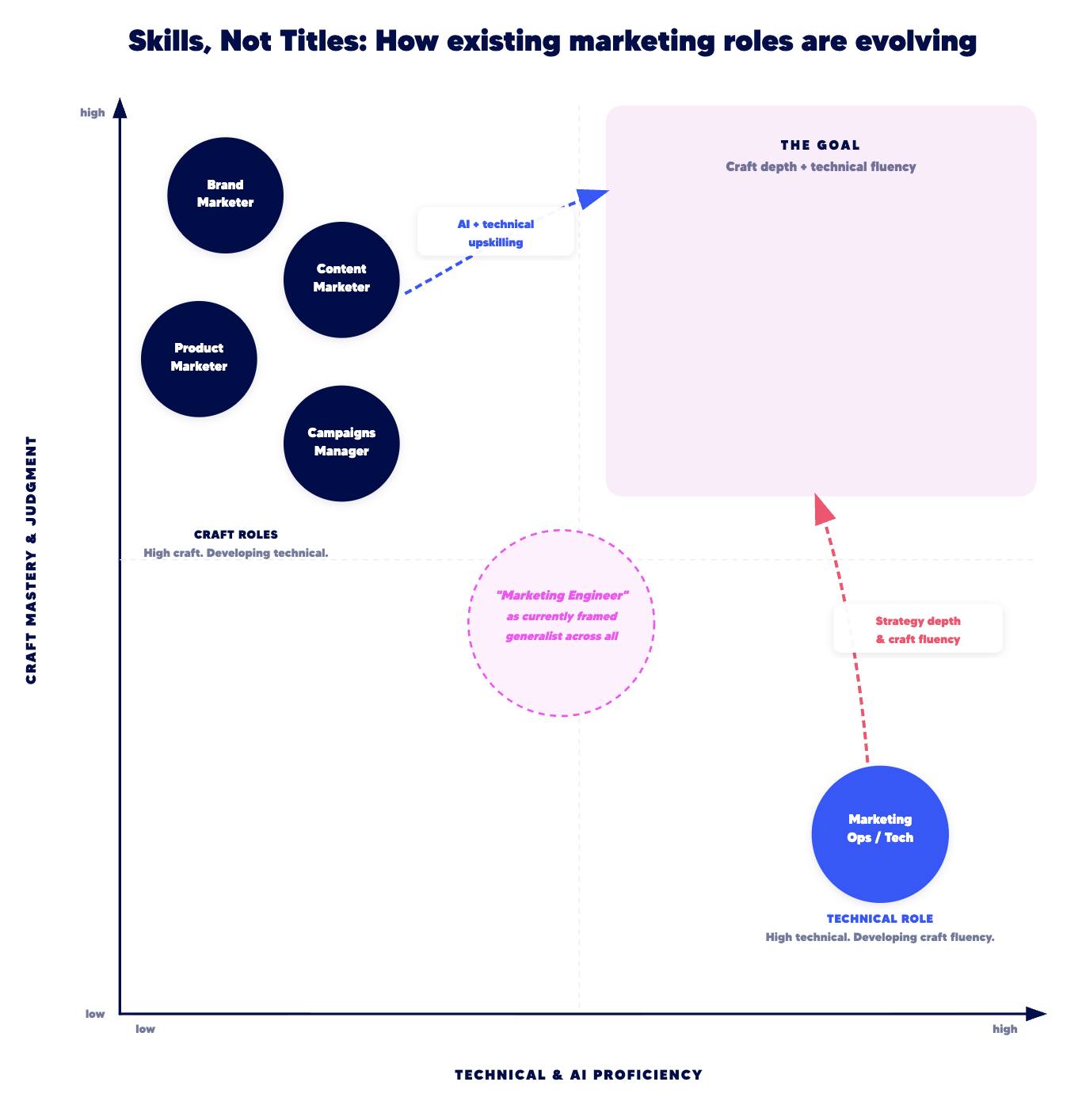
The Mini CMO model: how every marketing role reshapes when AI absorbs the work that forced specialisation in the first place. Click any role in the interactive org chart to see the legacy-to-AI-native transformation.
Read the post →
These six pieces are how I'm thinking about AI transformation as a CMO, and the order to read them in. They're sequential by design. Each one assumes the one before it.
The premise underneath all of them: AI doesn't fix what's already cracked in a team. It accelerates whichever gaps you've got. Your people, your operating model, and the clarity you give the work are the moat. AI is the lever.
Start here. Most failed AI pilots aren't a tools problem. They're a clarity problem. Unclear customer, undefined roles, no shared definition of done. This piece is the diagnostic: the five questions to ask before you blame the model. Skip it and everything downstream stops looking like the same problem.
Read the post →
Once you've named the gaps, this is how to close them. AI makes fast teams faster and misaligned teams misaligned faster. Read this for the four things only a leader can do, in the order they have to happen: define what good looks like, paint a vision worth moving toward, build the structure, calibrate the talent.
Read the post →
Article 2 said to define what good looks like. This is how. Includes a worked example: the six First Principles I built with a 40-person B2B SaaS marketing team, and how WGLL shows up in hiring, calibration, performance reviews, and the hard conversations most leaders avoid.
Read the post →
The high-level case for how marketing roles need to evolve. Hiring one “AI-native marketer” to sit at the centre of your team won't deliver what you think it will. Read this to see why the T-shape is still the model, and how craft experts paired with a marketing technologist outperform any single hybrid hire.
Read the post →
Article 4 made the case for craft + technologist over a hybrid hire. This is how that idea becomes an org structure. The Mini CMO model in detail: one marketer owning an audience end-to-end, with Craft Custodians as strategic partners. Includes an interactive org chart showing how each CMO direct report transforms from legacy to AI-native, the time savings each transformation unlocks, and examples of the AI files that sit atop each workflow.
Read the post →
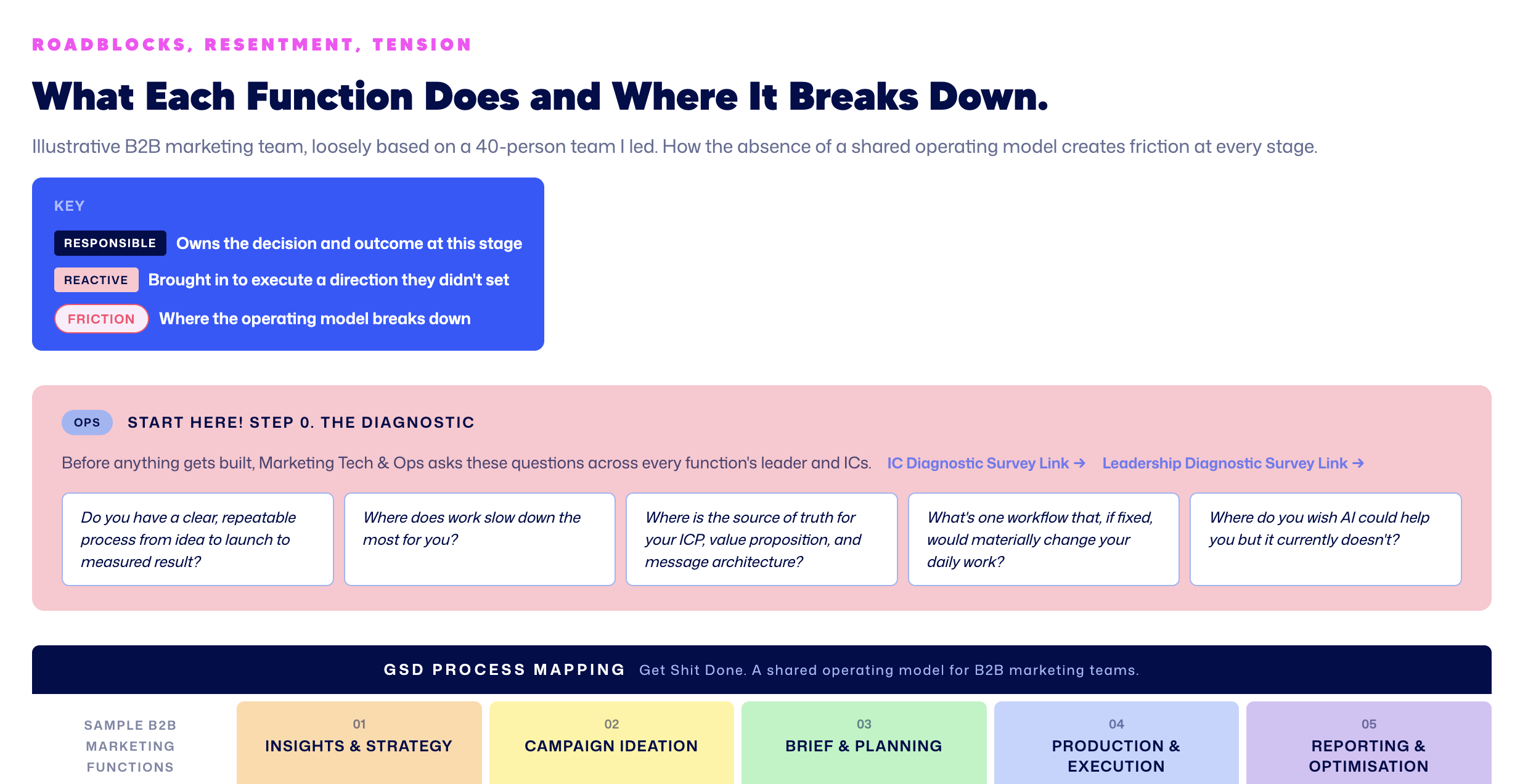
You can't compress, hand off, or improve what you can't see. Process mapping is the unsexy infrastructure that turns one-off AI experiments into compounding gains. This is the workshop guide: what to look for, who should run it, and the baseline craft skill every marketer needs to develop.
Read the post →Operator-grade pieces on the leadership work that doesn't get written about. Hard calls, real failures, the conversations most leaders avoid.
The workshop guide for mapping how your team actually works. Read the article →
Real questions from real people. The kind of stuff that isn't safe for LinkedIn and isn't easy to bring to your lead. Operator-grade answers. Completely anonymous.
More released weekly
Join to read →Three practical guides for CMOs and heads of marketing ready to move past disconnected AI experiments and build a system that actually scales — from framing the landscape to building your stack to leading the team.
From AI Fantasy to Real Moats: A State of the Union for CMOs, by a CMO
Build Your Brand OS: the Foundation for Your AI-Enhanced Marketing Machine
Build Your AI-Enhanced Marketing Team