TL;DR: AI makes fast teams faster. It also makes misaligned teams misaligned faster. Before the tools, there’s people work, and it’s the leader’s job, nobody else’s. This post covers the four things I do every time I take on a new team: define what good looks like before I meet anyone, spend the first 8 weeks listening instead of calibrating, build a structure that says the same thing as the business goals, and get a clear picture of the talent at 2–3 months. In that order.
Jump to:
- Few leaders want to do this part, and that’s a problem
- Three things that are a leader’s job, and nobody else’s
- Define what good looks like before you do anything else
- Now shut up and listen
- Your goals and your structure have to be built for each other
- Talent calibration: an honest view of the team you actually have
- Recap: What This Unlocks When People Come Before Process & Tech
Few leaders want, or know how, to do this part, and that’s a problem.
The predominant version of the AI transformation conversation is focused on efficiency. Faster outputs through automated workflows. Removing the number of human hand-offs from start to launch. A new tool that does in minutes what used to take days. This is both exciting, daunting, and a very compelling pitch to optimise towards because most leaders know they need to “do something with it.”
But what gets less airtime is what has to be true before any of that works. It’s way upstream of anything remotely AI- or technology-related. It’s the stuff that’s hard to do, emotionally taxing, and not always something for which a leader can control the outcomes.
Like when a team doesn’t know who owns a decision, a faster process will just get you to the wrong answer faster. When people are running toward different definitions of winning, AI amplifies the fragmentation. When the culture rewards the wrong behaviours like volume over quality “ship more content! we need moaaarrr content!” you haven’t built an efficient team. You’ve built an efficient machine for producing the wrong results.
Tools don’t fix any of that. They never have, and never will. We’re going around the same tools-before-people-before-strategy merry-go-round again.
But you know who does fix that dysfunction? The leader does (or they don’t… twist!).
These 3 things are a leader’s job, and nobody else’s.
- To define what good looks like (WGLL), in writing—explicitly—before anyone fills the gap with their own interpretation.
- Give the team a vision for this AI transformation that makes the future feel worth moving toward, not threatening.
- Build the structure, i.e. the roles, the operating model, the accountability loops, that makes both of those real every day, not just in a kickoff deck.
These three things aren’t sequential. They run together and reinforce each other. WGLL sets the bar. The vision gives people a reason to reach it. The structure makes reaching it possible every day, not just in the moments when the leader is in the room. Pull any one of them out and the other two get harder to hold together.
And here’s the part that often gets underestimated: when someone can see the line between their work and what the company is actually trying to do — and when they see their own growth being invested in, not just managed — they move differently. Not because they’re told to. Because they can see where they’re going and why it matters. That’s what happens when you get all three right: the company’s direction and the individual’s ambition stop being separate conversations.
This is the people work. It comes before the tools work. But most leaders skip it.
Define what good looks like before you do anything else.
If you’re a leader joining a new team, you don’t usually arrive “blank” or without a POV on what good looks like. Instead you were hired because of the fact you have a strong point of view.
Before I’ve met my team, before I’ve seen the pipeline numbers, before I know who’s thriving and who’s struggling I know what excellent already looks like. That’s not arrogance. That’s the job. If I can’t answer the question “what does good look like here, every day, regardless of role or level,” I have no basis for hiring, calibrating, or building anything. This is a learned skill. Every company each of us has worked in has a different rubric for what excellence looks like. But there are universal themes to look out for.
This is what I call What Good Looks Like (WGLL).
What it’s not: An operating manual. A job description. A values poster.
What it is: A decision-making tool. A shared standard written in language specific enough to be useful in a hiring cycle, in a performance conversation, in a moment when something isn’t working and you need a common frame to diagnose why.
Without it, people hit targets in ways that erodes employee and/or customer well-being, or people will miss targets in ways that are too opaque to diagnose. And that’s because there’s no shared language for what “good” actually means.
Without WGLL
Sounds something vague like “I need you to be more proactive. I’m not seeing the initiative I’d expect at your level.” It’s a verdict. The person has no idea what “more proactive” means in concrete terms, no way to measure whether they’re improving, and no clear action to take. The manager feels like they said something. They didn’t.
With WGLL
The conversation gets specific. Here’s an example of how I’ve used WGLL in performance conversations. The data is synthetic and not based on a real person. Same situation as the “without WGLL” example, but a completely different conversation. One gives the person somewhere to go. The other just makes them feel assessed.
“We have a principle called Own It. It means you act like an owner and you don’t wait for permission, you follow through, and you keep others unblocked. In the last two campaigns, I’ve seen you wait for direction on decisions you were positioned to make. That’s the gap. What’s getting in the way of owning that call next time?”
This becomes the foundation for your conversation together. And every manager on the team can have it using the same vocabulary, not their own individual interpretation of what excellence means.
Examples In the wild
Here’s what a real-world WGLL looks like. These are the First Principles I built with one of my teams — the same framework I’m describing in this post.
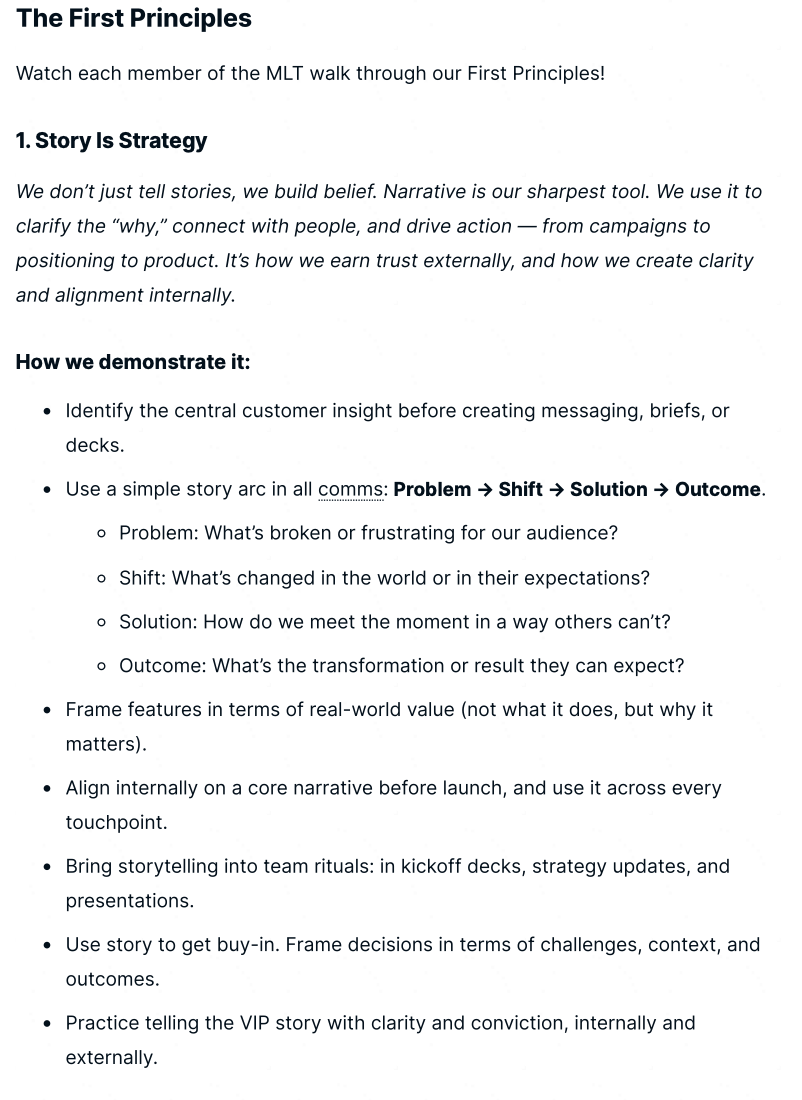
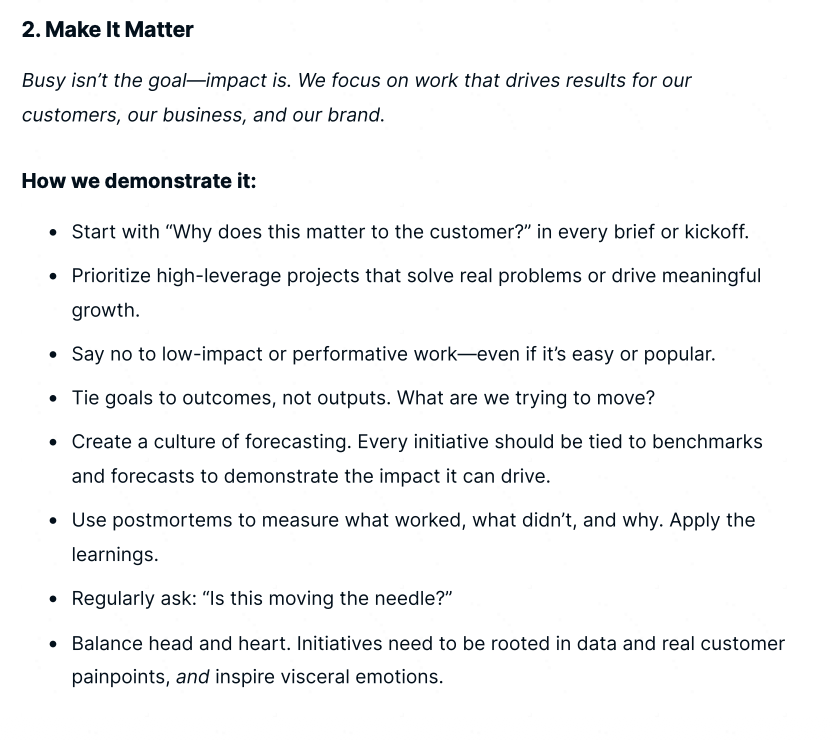
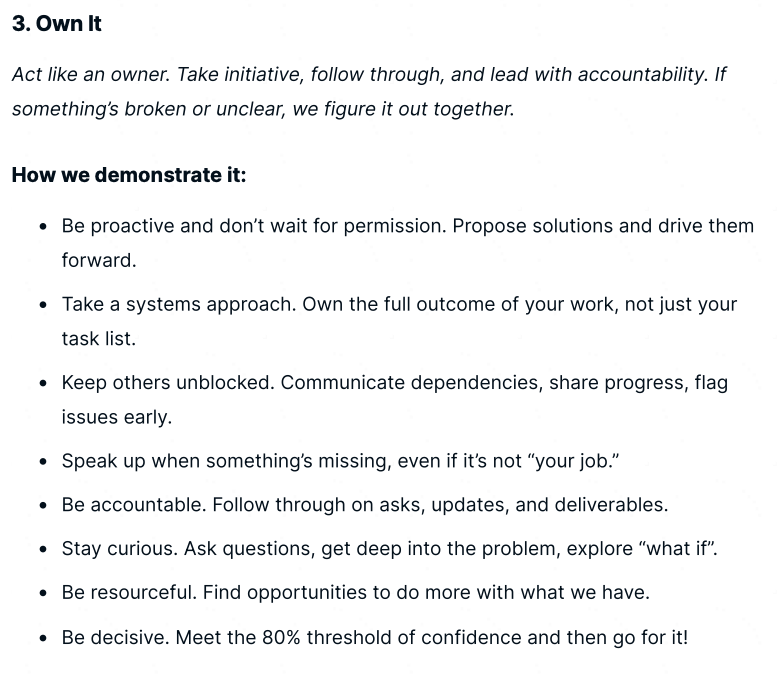
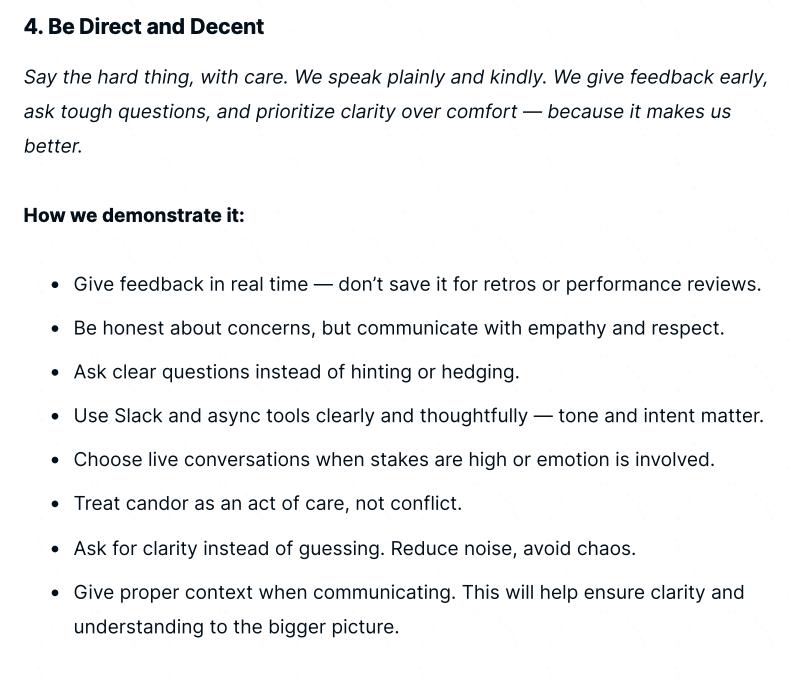
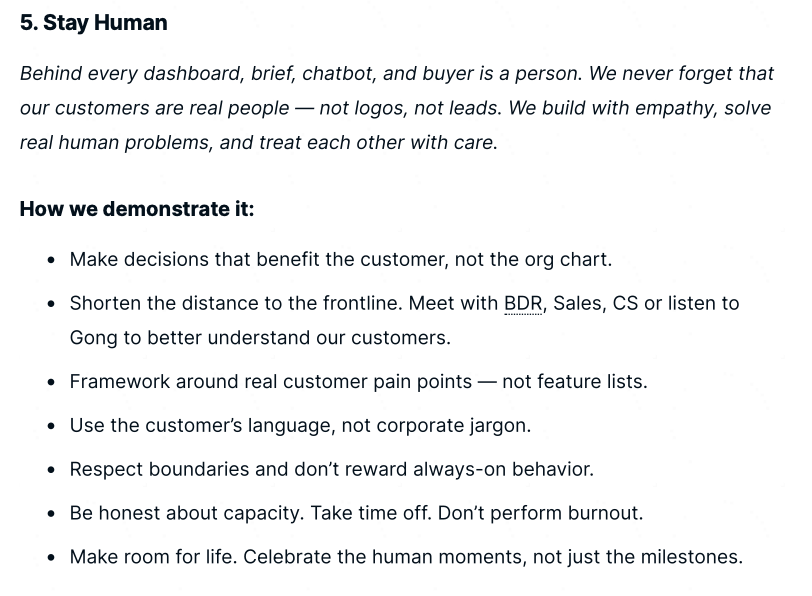
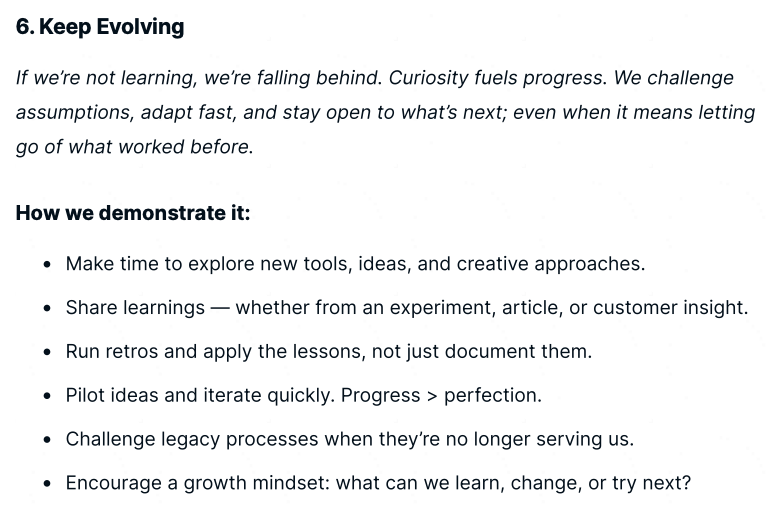
Netflix built their culture around what they call the “unusually responsible person” — self-motivated, self-aware, self-disciplined, doesn’t wait to be told. Their test for whether someone belongs on the team is simple and unsparing: would we fight to keep this person? Real values, they argue, show up in who gets promoted and who gets let go — not in what’s written on the wall. Klaviyo does the same thing in behavioural language: “Be meticulous in your craft,” “Drivers wanted,” “We’re 1% done.” Specific enough to hold up in a calibration conversation. Both worth reading as reference points.
The specific principles will vary by company and by leader but the practice of writing them down should be the same everywhere. Do this before you ever feel like you need them.
Now shut up and listen.
It’s really common for most leaders to spend the first few weeks of a new role listening and learning. We do it to form an opinion. I use it to form an opinion based on real insights and facts that later support something called calibration.
Doing a formal calibration either on your own, with your HR Business Partner (HRBP), or your leadership team before you’ve actually seen people work is guessing and then placing you is too risky and you won’t have the confidence or credibiltiy needed to hold an opinion of your team.
The observation period is where the real data comes from, and it takes longer than most leaders are comfortable with. It is what gives you that confidence and credibility to later make strong decisions with.
Here’s what I do.
Week one, I meet my first-team. My peers. The leadership team I now sit on. I want to understand what they’re running toward, where they’re stuck, and how marketing has historically shown up for them. Above all, and this is a theme across all levels of my listening, is to understand how decisions are made. This conversation shapes everything that follows. If sales has been burned by the wrong leads for two years, that’s context I need before I walk into my first “all-hands” or full team meeting. If product has been throwing briefs over the wall with no feedback loop (or vice versa), that’s a structural problem I’ll need to address but I need to understand it as a pattern before I react to it.
Week one, I also meet my direct reports. Not to evaluate, but to listen. What are they working on? What’s getting in their way? How do they make decisions? What do they wish was different? What motivates them? What’s the best and worst part of their jobs? I’m not forming conclusions yet. I’m opening a channel. I want them to know I’m interested in the reality of their work, not just the version that makes it into the status update.
Weeks two through four, I get to indirect reports, meaning the people who report to the leaders who report to me. Depending on team size, this takes time to do properly. The goal isn’t to cover ground quickly, it’s to make every person feel seen before the real work begins. People who feel seen are more likely to show you who they actually are. That matters for what comes next. I ask a very similar set of questions to them as I do to my directs.
Across both directs and indirects, I ask them to walk me through who they are beyond [Company]. I want to understand their entire background, their skills and abilities. It’s like an interview but without the grilling. I’m starting to mine for green shoots of potential.
Early in this period, I also share how I work. I call it an operating manual. It covers how I give feedback, how I prefer to communicate, what I expect from the people around me, and what they can expect from me. This isn’t a formality. It’s how I start to build trust. When people don’t know how a new leader operates, they spend energy guessing, and that energy should be going somewhere else.
Then I step back.
For weeks six through eight, I let people work in front of me. I watch how they handle ambiguity. How they communicate across functions. How they respond to feedback. How they behave when things get hard. First impressions form, and that’s unavoidable. What matters is that I give people the deliberate space to confirm or shift them. Most people will tell you everything you need to know if you’re paying attention.
The formal talent calibration — the 9-box, conversations with my HRBP, the path-forward decisions — happens at two to three months. Not before. If you try to do it earlier, you’re not calibrating. You’re reacting.
This phase also can’t be shortcut by AI. Pattern recognition requires input. The observation period is the input. No tool replaces the signal you get from watching how someone handles a hard conversation, a missed brief, or an unexpected pivot.
Your goals and your structure have to be built for each other.
This phase runs in parallel with the listening period, not after it.
As I’m getting to know the team, I’m also shaping the north star. The team structure comes when WGLL and role definition are clear. The Mini CMO model — which I’ll get to in a moment — gets introduced alongside roles, because one makes the other legible.
But first, the tension. Because the reason goal-setting matters is almost never articulated clearly.
Here’s what it looks like when marketing’s goals are off.
Marketing optimises for MQL volume and to hit the number, they cast a wide net. The result: a pipeline full of individual contributors when you sell to VPs, or a bunch of small deals when you’re an enterprise product. The coverage ratio looks healthy on paper but the quality is a different story.
Sales spends the first half of every call qualifying out. Win rates drop. Reps go back to cold outbound. Resentment builds. “Marketing doesn’t get it.” The feedback loop never closes because marketing is measured on volume, there’s no incentive to investigate why most of those MQLs never convert, and the same bad leads keep coming. The same conversation keeps happening in every pipe council or QBR.
Meanwhile CS is dealing with customers whose expectations were shaped by messaging the product couldn’t match. Churn goes up. Expansion stalls. The insight CS holds about what’s actually driving retention never makes it back upstream because it doesn’t match marketing’s goals.
Here’s what it looks like when the drift starts elsewhere in the pipeline.
Sales pivots to only pursuing deals above $100K ACV because of a gut instinct from one of the sales managers, or a comp plan change. Marketing isn’t in that conversation. They’re still targeting mid-market, producing content for a buyer sales won’t touch. The ICP cascade is immediate: personas are wrong, pain points wrong, proof points wrong. Headcount gets allocated to serve a strategy that’s already obsolete. Nobody has the shared view to even ask whether it’s the channel or the audience.
In both cases: everyone is technically winning by their own metric. But the business isn’t growing and nobody can agree on why and it’s because they weren’t running toward the same thing from the start.
Why? Because the fish rots from the head down.
I know, it’s a gross analogy and pretty crass. But I’ve held onto this for years because it describes the root problem just right. The meta-point: this isn’t a marketing problem, a sales problem, or a CS problem. It’s a leadership problem. These divergences happen when leaders aren’t communicating at the top and when they’re incentivised to optimise for their own function’s wins and nobody has established a shared definition of what good looks like at the org level. The structural rituals that prevent this like a quarterly ICP review, a weekly pipeline council, a squad structure where marketing, sales, and CS are in the same room, only work when the leaders building them are already aligned.
”Ack! I’m sooOoOo busy, hbu?!?! 🥴”
And what makes all of this sting more: everyone is always so busy. Back-to-back meetings. Meetings that should’ve been an email. Even when your pipeline is flat or declining. That’s because people without a clear north star fill the gap with activity. They look busy. They produce outputs, attend meetings, ship things. At the end of the quarter, nobody can explain what moved. This is how misalignment hides. It’s not in a sitcom-like-argument, but in the appearance of productivity when there’s no shared definition of winning.
AI makes all of this more urgent. Every AI-powered workflow you build optimises toward a target. If each function has a different one, you don’t get faster growth — you get faster fragmentation. Campaigns launch more efficiently, content publishes more frequently, and none of it compounds. You haven’t automated your marketing. You’ve automated the misalignment.
Clear is kind.
So what does clarity actually look like? It’s one primary KPI everyone can see their job from. A number with a line connecting it to the business. Everything else becomes derivative. Something like: increase sales-qualified pipeline from 50 to 200 opportunities per month by end of year. Or: grow pipeline coverage from 1x to 5x by the end of the year. Simple. Singular. Shared.
Goal clarity at the leadership level is the starting condition, not the finish line.
If the org structure below it is still built around functions — where marketing hands off to sales, sales hands off to CS, and nobody holds the full arc — the same fragmentation recreates itself one level down. The fix isn’t better hand-offs. It’s removing them.
The org structure is the embodiment of your goals and your customers brought to life. Enter: Mini CMOs.
Org structure is not just boxes and lines on a page. It’s a mobilised machine that explains itself every day. And if the structure doesn’t reflect the goal — if functions are still siloed, accountability still disappears at every handoff, and no single person holds the full arc of an audience — then no amount of leadership alignment at the top will hold.
This is where the Mini CMO model(™️**)** comes in.
The principle is the same one I’ve been describing, applied to the front lines. If leadership has to be incentivised toward a shared outcome, so does every person below them. The structure has to match the mental model all the way down.
Organising by function creates the structural conditions for misalignment by design. Each function optimises for its own output. The gaps between functions are where accountability disappears and the buyer gets lost.
Organising by audience closes the gap. Each GTM marketer owns a vertical end-to-end — strategy, execution, reporting.
From ICP definition to first touch to pipeline to retention signal. They are, in effect, the mini-CMO for that audience, answering to the same north star leadership defined at the top.
The accountability rings are explicit:
- Sales × Marketing: the point person or captain or “directly responsible individual (DRI)” is accountable to pipeline (sales qualified opportunities), not just MQLs. They own the story from first touch to sales-accepted.
- Marketing × CS: the audience owner holds the full lifecycle. Acquisition through retention isn’t two separate jobs anymore.
- Marketing × Product: someone from product is embedded in the vertical squad rather than somewhere in the dark. This enables the distance between marketing and product —which I find to often be football fields away from one another —to share field notes more closely about what customers love and need.
I’m introducing the Mini CMO model here — alongside role definition, not as a separate structural conversation — because one makes the other legible. You can’t define what a role is responsible for without knowing what unit of business it’s organised around.
Mindset. Mindset. Mindset.
This model asks something specific of the people in it. The mindset has to be entrepreneurial — act like an owner, not like a function. Not “I run campaigns for the enterprise segment” but “I’m responsible for the full health of this audience, from first touch to renewal.” That’s a different relationship with the work, and not everyone is wired for it. It’s part of what WGLL and the 9-box help you see.
When I’ve made this shift, the feedback from the team has been consistent: people say they love it. Not because it’s easier because it ain’t! But because they finally have the full view. They can think top to bottom, own the entire experience, and draw a direct line between their decisions and outcomes the business actually cares about. That kind of scope doesn’t feel like pressure. It feels like trust. And it feels like investment in them.
And a note on where this is bringing B2B Marketing teams.
IMO, the Mini CMO model is pointing toward something bigger — a future where one marketer, well-supported by AI, can own a full audience lifecycle end-to-end. Not today’s reality for most teams. In practice, I’ve usually split this role in two: one person owns new business pipeline, another owns customer expansion. Same audience, two mandates.
But AI is collapsing that split. When the barriers between strategy, production, and launch get low enough, one person can own the full slice of an audience, end-to-end — acquisition through retention, first touch to renewal. The structure you build now is what makes that possible. Crazy. I know.
Talent calibration means creating an honest view of the team you actually have.
Formal calibration happens at two to three months. I’ve spent time listening, learning, gaining deep context and insight across all altitudes — my peers, directs, indirects, cross-functional partners.
By the time I sit down for this conversation with my HRBP, I have real insights backing up or shifting my first impressions. I’ve watched people handle ambiguity and change, respond to feedback, communicate across functions, and show up when things got hard. I’ve seen how they behave when they think nobody’s paying attention. I’ve seen who they become under pressure.
Performance × Potential
It doesn’t really matter which framework you use, and I’m not about to tell you “this one is the ULTIMATE!!” Rather, I’ll tell you why you need to do it, and how you could do it based on what’s worked for me. What I am looking for lies at the intersection of someone’s consistent performance, and their potential for growth. I use the 4- or 9-box grid.
The 9-box I use has two axes: current performance and growth potential. Nine boxes. Each with a clear path forward.
| Low Performance | Medium Performance | High Performance → | |
|---|---|---|---|
| High ↑ |
Develop
High potential, performance still building
|
Rising Star
Strong potential, performance growing
|
★ Succession Candidate
Stretch roles, expanded scope, more complex problems. These are the people you build around.
|
| Med |
Monitor
Moderate potential, performance lagging
|
Middle Band
Where most teams live. Coach up, develop with intention, be specific about what growth looks like for this person in this role. This is where WGLL becomes a calibration tool — not just platitudes.
|
Strong Contributor
High output, growth ceiling may be limited
|
| Low ↓ |
Hard Conversation
These are the conversations nobody wants to have, and that most leaders defer too long. Deferring doesn't help the person. It doesn't help the team. And it signals to everyone watching that the bar is negotiable.
|
Watch
Some performance, limited potential upside
|
Specialist
High performance, limited growth potential
|
The 4 dimensions that dictate the probability of future potential.
These aren’t abstract attributes. If you’ve written your WGLL in behavioural language, you already have names for most of them. The dimensions below map directly onto what high potential looks like on your team, and they’re what I’m watching for during the observation period.
- Growth orientation. Do they lean in when things change, or pull back and wait for it to blow over? This shows up in how they respond to a process change, a reorg, a new tool being introduced. The lean-in is the signal. In WGLL terms, this is your “Keep Evolving” or “Act Like an Owner” dimension — whatever your language is for it.
- Resilience. Can they work through ambiguity without needing to be rescued? Can they receive hard feedback and use it rather than deflect it? I’ve seen people with all the right skills fall apart under uncertainty, and people with fewer credentials thrive because they stayed steady. This is the difference between what someone could become and what they’re already showing you. In WGLL terms, this is your ‘Own It’ dimension under pressure — whatever your language is for it.
- EQ. Can they manage across functions, build trust quickly, and represent their audience rather than just their to-do list? In an audience-based operating model, this matters more than almost anything else. In WGLL terms, this is your ‘Stay Human’ dimension — like in the examples I shared.
- Communicates with conviction. Can they say the thing that needs to be said — not just in a safe room, but in the one where it’s uncomfortable, where there’s something at stake in saying it? And can they say it in a way that actually lands? Intellectual courage without communication craft stays stuck in your head. The highest-potential people I’ve worked with could almost always do both: tell a story, name a problem clearly, and bring a room along with them. In WGLL terms, this would be my example of ‘Be Direct and Decent’ and ‘Story Is Strategy’ working in combination — whatever your language is for it.
These attributes show up during the observation period: in the 1:1s, in the cross-functional meetings, in the moments between the formal moments. You just have to be paying attention.
When WGLL hasn’t been explicitly defined for a team, people default to what’s familiar and what they’ve learned. Not because they’re choosing the wrong thing, but because no one has named the right one. When you find this pattern in clusters, it’s a signal that the bar was never explicitly set.
Calibration is a clarity exercise, not a verdict. Name where people are. Build from there.
The calibration conversation itself isn’t a performance review. It’s a clarity exercise. What does good look like in this role? Is this person trending toward that or away from it? The 9-box tells you where someone is. WGLL tells you what direction they’re moving. Talent and potential aren’t the same thing. You can be skilled, experienced, and clearly smart, and still not be high potential if the behaviours aren’t showing up in the work. The calibration conversation is where you name where someone actually is, not where they could be.
Calibration is also a structural exercise. Who’s ready to own a vertical in the Mini CMO model? The 9-box tells you. Assigning a DRI role to someone in the wrong box doesn’t just slow things down, it creates the kind of inconsistency that erodes trust in the system—between your team and you, your team and their peers, the business and marketing, and so on. When you get it right, the model starts to explain itself.
Recap: What This Unlocks When People Come Before Process & Tech
Here’s what we covered in this post, the tools that go with it, and what it unlocks:
- Define what good looks like (WGLL). Write it before you need it, in language specific enough to hold up in a performance conversation or a hiring decision. (Netflix Culture | Klaviyo Values)
- Shut up and listen first. Weeks 1 through 8 are for observing, not calibrating. Meet your first-team, your directs, your indirects. Share your operating manual. Let people work in front of you before you form a view.
- Set the goals and build the structure around them. One shared KPI. An org structure that reflects it. The Mini CMO model to close the gap between functions and the buyer.
- Calibrate at 2-3 months, not day one. Use the 9-box (performance x potential) or a similar framework and assess against skills and abilities like growth mindedness, resilience, EQ, communication. WGLL is your frame for what potential actually looks like on your team.
Once you have all of this in place, you’re ready to define how the work actually moves. Map How Your Team Works Before You Automate Anything is where the people work meets the process work: you can have the right team, the right structure, and a shared goal, and still have no idea how work flows from brief to launch. That’s the gap process mapping closes, and it’s what has to happen before you hand anything to AI.