TL;DR: You can’t improve, compress, or hand off to AI what you can’t see. The reason most AI experiments don’t compound into anything real is that the underlying system is invisible: tribal knowledge, informal process, no clear owners. Map it first. Fix the gaps. Automate one thing. That’s how it builds.
Jump to:
- Process mapping is like starting a diet
- Process mapping is everyone’s job
- What you’re looking for when process mapping
- How to run a process mapping workshop
- The craft skills you’re building
- What’s next
As a follow up to my last deep dive on where I think B2B marketing roles are evolving in 2026, and that I think we’re getting tripped up in titles vs skills, I want to zoom in further to an essential skill that every marketer should really start to get their heads around. I say this as someone who has keenly felt the ambiguity and “blurriness” of not being able to exactly leverage AI at scale across a large marketing team. For context, I knew that saying to the team “just rip ‘er” wasn’t the right approach. But stopping the experimentation was also not the right answer.
I knew that the critical skill underpinning all of this experimentation and individual skills acquisition was missing. It’s got nothing to do with AI, but everything to do with it.
Process mapping.
Yes. You heard me.
I think it’s amazing to approach learning AI at all angles: jump right in, see what a prompt delivers, get your team running experiments, test everything. But we are hitting the inevitable wall where the underlying system is missing. The one that would connect what Jack in PMM is doing, to what campaigns Sarah is launching, to Alice Commercial Sales’ pipeline number for H2.
Every marketing team has processes and ways of shipping. But very few are documented. I’m reminded of every time I’ve started a new role, and said to myself: “THIS time will be different. I’LL clean it all up. We’re going to get our house in order! Huzzah!”
Process Mapping Is Like Starting a Diet: You Know You Should. You Never Actually Do.
For many teams, it looks something like this: the processes that are actually written down are usually aspirational — like when you first kick off a new diet and think you’re always going to stick to it, forever and always. It could be that these processes were built for a team shape and size that no longer exists. Or they were last updated two reorgs ago, when the former operational whiz was still on the team.
What fills the gap is informal process. Tribal knowledge. Unwritten rules. There’s the process your team runs, and the one it thinks it runs.
A process that lives inside one person’s head isn’t really a process. It’s a preference. And preferences are fickle: they shift with workload, mood, and tenure.
When the person who held the process in their head disappears, the process doesn’t just slow down. It vanishes. And nobody knows what they lost until something stops working.
The consequences are predictable: teams are perpetually reinventing the same wheel, shipping inconsistent output, holding resentment towards each other because folks are being treated as service counters, and as a team, carrying a universal sense that “things feel broken all the time.” Not because people are bad at their jobs. But because the system is invisible and unpredictable. And you cannot improve, compress, or hand off to a new hire or AI tool what you can’t see.
This is not a technology gap. Not a headcount gap. It’s a visibility gap.
Process mapping is everyone’s job. Not just ops.
In a situation as I’m describing, I’ve often seen the instinct to hand process documentation to Marketing Ops, RevOps, or whoever is “good at organizing things.” That instinct will fail you.
The person who does the actual craft work and knows how the “sausage gets made” every single day, is the only one who can map it accurately.
Ops can document a process once it’s been explained to them. But they can’t see what’s happening in the in-between moments: the informal Slack ping to your trusted advisor before anything goes to the CMO, the approval step that only exists because of one bad campaign three years ago, the approval requirement for someone who left 18 months ago that never got removed.
Understanding how marketing comes to life — from the moment a brief is initiated to the moment something ships — is not a leadership skill. It is a baseline craft skill. But this baseline craft skill is missing from most teams.
Here’s what the absence of it actually costs: a campaigns manager who doesn’t understand what brand needs to sign off on will inadvertently add rework time into every single cycle. A paid media person who doesn’t know how their output connects to what sales receives will keep generating leads that go nowhere. A social manager who doesn’t understand what happens upstream will always be briefed too late.
Your Decisions Don’t Stay in Your Lane
Systems-level thinking — the ability to see what your decisions do to everyone downstream — is the skill underneath all of this. You understand that when you brief social at step nine of ten, you’re cutting their time, lowering the ceiling on what they can produce, and if it keeps happening, you’re implicitly telling them that last-minute work is just how things go around here. You know that you’re treating your partners as deli counters. That doesn’t feel good or inspiring.
But the marketers who learn to see beyond their own lanes are the ones who advance. That altitude shift doesn’t come from a title change. It comes from doing this work and knowing how your decisions impact the entire marketing system by mapping it, naming the gaps, and owning the consequences if the rules aren’t followed.
So understanding the problem is one thing. Defining the process is another.
What does that look like in practice?
It’s very tactical, it can be fun, and involves lots of sticky notes and smelly markers. In the context of mapping how campaigns get launched, it starts by bringing a group of people together to document what a campaigns manager actually does to ship a campaign. This exercise requires both the granular knowledge of how the work gets done and the authority to say “this is how we do it here.” It cannot be handed to an ops person or a marketing engineer. It has to be led by someone with skin in the game who has made the sausage first-hand.
Let’s dig in to Process Mapping. You can bookmark this, print it — go ahead and make it your own!
What you’re looking for when process mapping.
I’ve distilled it down to three core things. When you map a process properly, you’re looking for:
- What’s broken
- What’s bloated
- What has no owner
What’s broken?
Things like missing handoffs. Steps with no clear trigger or output. Ownership that belongs to “a team,” which means no one owns the thing. These are the gaps where work falls through. Where people get pissed they’re not looped in sooner.
I remember doing this exercise in the first few weeks of starting a new role. Before we’d even gotten deep into mapping the process, we uncovered that the marketing team and sales were measuring completely different things. Marketing was reporting on MQLs. Sales was measuring sales-accepted opportunities. Marketing thought things were great, that volumes were healthy, and therefore the team was doing its job. But the reality was that qualified pipeline was at an all-time low, coverage was under 1x, and sales was watching the numbers decline month over month.
Realigning on shared metrics shifted the entire worldview for marketing. A sense of urgency emerged. The way of working that had optimized toward MQL volume simply would not endure. We needed to take the house down to the studs and rebuild methodically, precisely, and with urgency.
Once we realigned on marketing’s role to drive growth, not just volume, the team became Friction Finders. We stopped just spotting that something was slow. We started understanding why — and whether it was a structural gap, an unclear owner, or a step that no longer needed to exist. It was painful and every single role and function on the team had to adapt.
What’s bloated?
This could be the five-step approval chain for getting a LinkedIn post out. The three content log spreadsheets doing the job of one. The three formats needed for three different audiences whenever a campaign launches. The campaign plan that takes eight weeks when it could take three. Bloat is usually the result of complexity, or scaling the size of a team without adjusting its working models, or caution and indecision learned over time. Each step made sense, and felt needed, when it was added.
But the diagnostic question is simple: if this step disappeared tomorrow, would the output suffer? If the honest answer is no, it’s bloat.
What has no owner?
This is the highest-risk category. Tasks that “everyone” does, which means no one does consistently. These are the points that fail silently — done when someone remembers, skipped when they don’t.
Some examples that show up in almost every team:
- The post-campaign retrospective. Everyone agrees it should happen. It’s like the diet I mentioned earlier — “this time we will do it! and we will take all the lessons and apply them to the next campaign! Pinky swear promise!” But the calendar invite comes too late or not at all. When it does happen, the format, attendees, and next steps are inconsistent from one retro to the next, and the findings go nowhere.
- Competitive intelligence. The team “keeps an eye on it.” Or it’s available in bucket loads, but it’s not clear how it should be used, so it sits stale in a Slack channel or Crayon. It gets missed in the campaign planning process because it’s siloed.
- The ICP update (my favourite). Sales shares in a monthly review that the leads aren’t quite right, like they’re spending too much time on small deals, or we’re too expensive. Marketing hears it. Marketing really wants to help. But the ICP document is a monolith and is only refreshed every two years as a one-off project that quickly goes stale again. Because doing ICP work is hard and takes time.
- Campaign Brief QA — “checks and balances before all systems go.” This is determining whether a campaign brief is complete before work starts. It is supposed to be someone’s job. Under pressure, it becomes no one’s, and the campaign goes to execution half-built.
If you can’t name the specific person who owns each of these on your team, you’ve found your first audit priority.
Take action: How to do a process mapping workshop.
Step 0: Before anyone gets in a room, collect some data.
Before you book a session, the team’s marketing leader needs to run two separate surveys: one for leaders and one for individual contributors. Keep them separate. Do not share results between groups before you’ve collected everything.
The reason for two distinct surveys is aperture. Nobody sees the whole process. Not one person. Leaders see the intended version: the one that lives in the strategy doc, the one that should work. ICs see the real version: which steps get skipped under pressure, whose informal sign-off is actually required even when it’s not on paper. That’s where the process falls apart.
The raw divergence between what leaders describe and what ICs experience is the most useful thing you’ll read.
It’s also why no single person — not the CMO, not an ops hire or marketing engineer, not a consultant coming in cold — could map this accurately alone. The full picture only exists across all levels and depth of experience.
Both diagnostics are available as ready-to-use Google Forms.
Make a copy of each, run them separately, and collect all responses before the session.
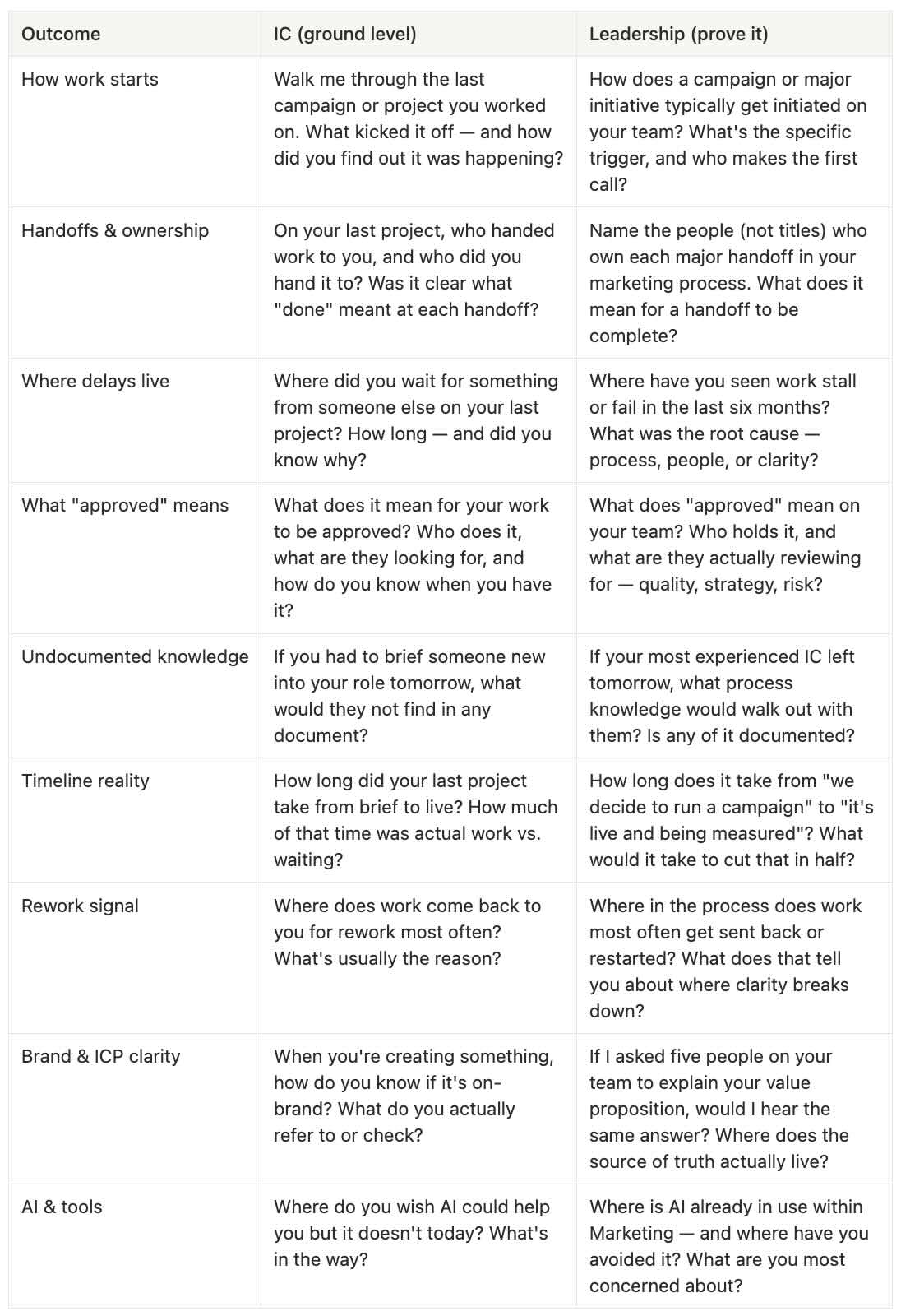
Here is how the two different altitudes compare at a glance, so that after you’ve done the data collection, you’re able to directly compare the ground level insights with leadership’s perspective. These questions are designed to surface what actually happens, not what’s supposed to. Collect both sets of answers before the session. Don’t tidy them.
Step 1: Ahead of the session, send a few short pre-reads.
The diagnostic is done. Before anyone gets in a room, three things need to happen.
- Send the pre-read. Share the anonymized diagnostic findings with everyone who will be in the session. Not a summary, but the actual divergence where leaders described the process one way and ICs described it completely differently. Let people sit with that before they walk in. The discomfort is the point.
- Set the frame in writing. Tell participants what this session is: mapping what IS, not what should be. Not defending. Not explaining why a step exists. That conversation comes after the map is complete. Put this in the calendar invite so you’re not spending the first twenty minutes of the session establishing it.
- Get the right people in the room. The people who do the work, not only the people who manage it. Managers describe the intended process. ICs describe the real one. If you’re mapping the campaign launch process as an example, the process crosses functions, so make sure one person from each side is present.
Step 2: Run the workshop.
Open with one ground rule.
You are mapping what IS, not what SHOULD be. This is not about defending or explaining why it works this way. Everyone is just describing. And then fixes come after the map is complete.
I use something called the Get Shit Done (GSD) model when it comes to articulating the campaign launch process. Feel free to use it as your starting point (tab 1). The GSD gives people a visual model of the full sequence of how work moves from brief to launch. The first tab in the spreadsheet details what you’re aiming to uncover in each column and row. The second tab is something you can use directly in an IRL workshop. Make a copy of the Google Sheet to make it your own.
Capture everything in a shared document in real time. Don’t clean it up as you go. Fidelity matters more than neatness. The spreadsheet format matters because it’s a structure that an AI system can eventually read. It’s not just documentation for humans — it’s the beginning of a machine-readable process layer.
How to run the session:
- Start with one person’s version. Have them walk through the process step-by-step while someone else captures it live.
- Let the full picture land before anyone adds or challenges.
- Then open it up: Where does your experience differ? What steps are missing? What happens between step three and step four that hasn’t been named yet?
- Apply the three lenses — broken, bloated, unowned — to everything you’ve captured.
Close with one priority decision.
Which single thing, if fixed, would have the highest impact on time-to-launch? Ownership governance means this decision has a name on it before anyone leaves the room. Not “the team will look into it.” Put a person, a deadline, a format for reporting back to this group.
Step 3: After the workshop. Turn the map into an operating system.
The workshop is done. You have pages of raw, unfiltered, sometimes uncomfortable truth about how your team actually works. Now what?
This is where most teams drop the ball. They walk out of the room energized and connected, then the next campaign fires up, and the findings sit in a doc nobody opens or feels overwhelmed to open. The process doesn’t end up changing. The map gathers digital dust. Six months later, or when a new leader joins, someone suggests running the session again. Sigh.
Here’s how you make sure that doesn’t happen.
Within 48 hours: synthesize while the room is warm.
Don’t write a formal report. Send one Slack message or drop a short shared doc. Pull three things from what you captured:
- The single biggest “we didn’t know this was broken” finding.
- The most common point of bloat.
- The step with the clearest ownership gap.
Three things, named, visible to the whole team. This isn’t the full action plan: it’s telling every person who was there that the work is continuing.
Within one week: set three named next steps.
Not a roadmap. Not a project plan. Three things: one person, one action, one deadline each. Anything more and nothing moves. The job at this stage is maintaining momentum, not driving completeness.
Assign ownership out loud, before anyone logs off. The person who owns something should say it back to the room: “I’ve got the campaign brief QA / checks and balances process. I’ll have a draft owner and checklist to the team by Friday.” That’s what you’re looking for.
Pick one thing to automate, and start there.
Look back at your GSD map. Find the step that meets all three criteria:
- High-frequency
- Currently manual
- Requires no human judgment to execute
That’s your first automation candidate. For most marketing teams, this tends to be one of these:
- Campaign brief intake: moving from a Google Doc template manually filled in, to a mostly populated brief template with your real-time VOC and insights, routed to the right people with the right level of context.
- Approval routing: triggering the right reviewer at the right stage, rather than relying on someone to remember to ping them.
- Post-launch reporting: pulling performance data into a shared template on a set cadence, without someone manually assembling numbers. The humans focus on the insights and storytelling, rather than data mining and building decks.
You don’t need to automate the whole campaign GSD process. Automate one step, prove the reliability, build trust in the system. Then move to the next. This is also the bridge to what we’ll cover in the next piece: the full workflow automation roadmap — how to take a big thing and break it into bite-sized chunks so that in the next 6-12-18 months, you’ve gone from doing a few chaotic experiments to something that actually compounds.
Build your versioned operating documents.
This is where the map becomes infrastructure. What follows is the set of documents every AI-augmented marketing team needs — and that most teams have never actually built because this is all so new and emerging. You’re not alone.
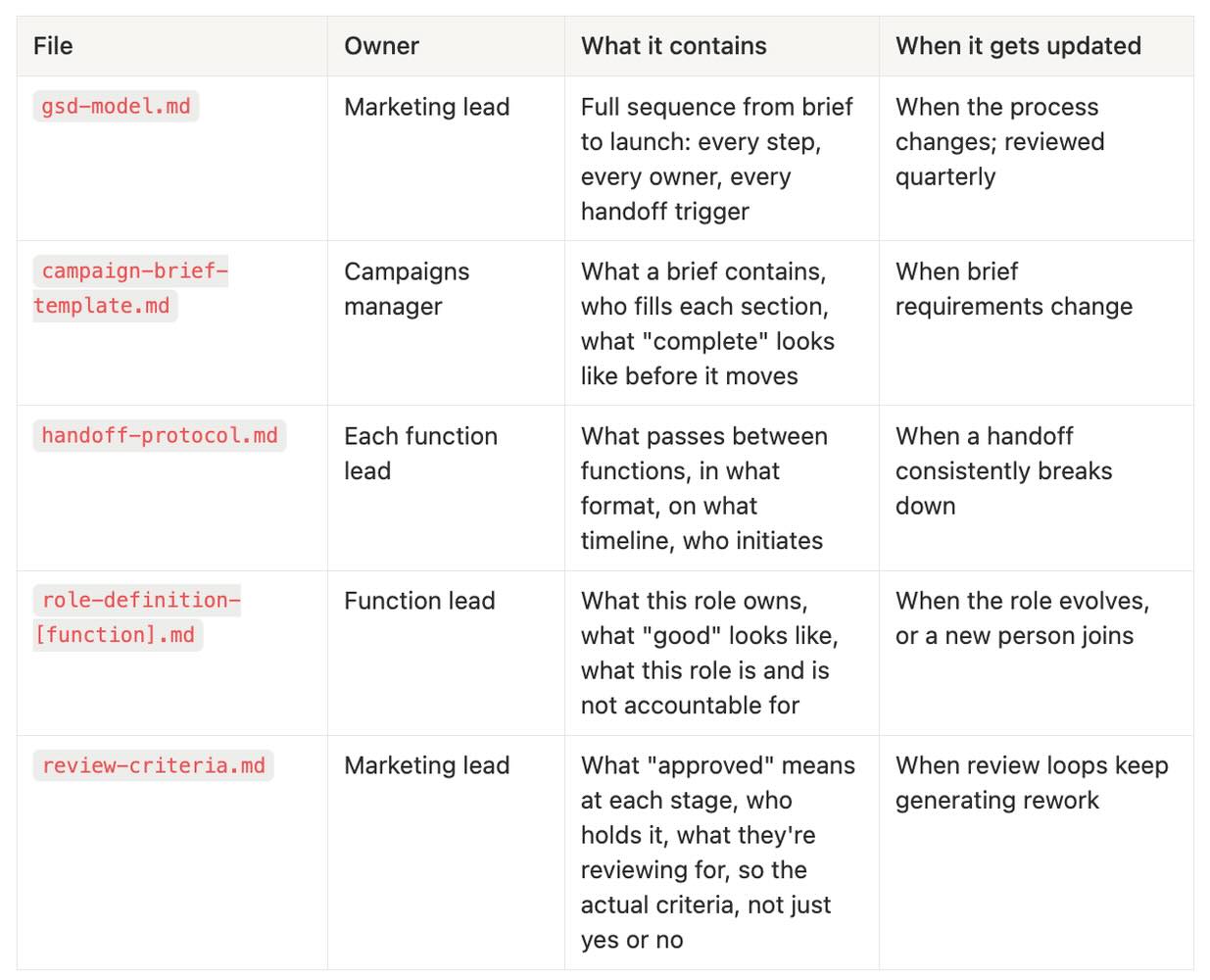
Every file has a named owner. Every file has a trigger for when it gets updated. Neither is optional. A file with no owner puts the system at risk. (I will be showing what good versions of these types of markdown files look like in upcoming posts. Stay tuned.)
Why this matters more than it looks like it does.
Most marketing teams using AI right now are running consumer-grade: everything built on top of a language model via prompt. It’s fast to start and gets you a long way — like 80-90% of the way. The problem is reliability. The context window expires. You correct it and it reverts. You ask why it gave you what it gave you, and the answer shifts. It’s making you happy. It works until you need consistency, and then it doesn’t.
Enterprise-grade AI is built differently: on a data foundation, a semantic layer, and an ontology. An ontology is the business rules, definitions, and ownership structures the system runs on. The language model is one layer in the stack, not the foundation. It doesn’t drift when the context resets because the rules aren’t stored in a prompt. They’re baked into the architecture.
Your .md files are your ontology.
By defining how work moves, what each role owns, what “approved” means, and what a brief contains, you are building the foundation layer a more reliable AI system needs to run on top of. The teams that do this work now will be able to hand it to a more enterprise-level technical partner and say: build on this.
In this new world: process mapping isn’t good hygiene. It’s infrastructure.
Marketers, here are the craft skills you’re building.
You’ve stayed with me this far on process mapping. Yes, a sexy topic. On LinkedIn. Happy Monday!
It’s important for me to articulate these skills as unlocks — not just to better leverage AI, but as career-building skills. You’re primed to become more of a systems designer, not just a lane manager. As a CMO, the biggest asset to me was building systems-thinkers because it ensured it wasn’t just on me to see the wide aperture. My next line leaders were thinking at the systems level too.
Here are the six I’ve distilled:
- End-to-end process fluency. Understanding how marketing comes to life — the full sequence, not just your part of it. This is the baseline everything else builds on. You can’t improve, compress, or hand off what you can’t see, and this is the skill that makes it visible.
- Friction identification. Seeing where time leaks and why. Recognizing whether a step is load-bearing or just historical. Knowing the difference between a slow process and a broken one — and being the person in the room who can name it precisely.
- Time-to-launch compression. Having a point of view on what to remove, what to collapse, and what can run in parallel. Map first, then compress. AI can dramatically accelerate a documented, well-owned process. It cannot rescue an invisible one.
- Ownership governance. Accountability is table stakes. This is accountability documented — following up when a handoff breaks, asking the hard question when a step has no name on it, making sure the fix outlives the meeting. This happens at every level.
- Documentation discipline. Translating what lives in your head into something written, shared, and versioned — precise enough that someone new could follow it and produce the same output. This gets built by doing it, not by planning to.
- System-level thinking. Seeing what your decisions do to everything downstream. This is the altitude shift that separates people who stay in their lane from the ones who understand — and eventually lead — the system they’re part of. It’s also, not coincidentally, the skill that makes you invaluable when leadership is deciding who gets more scope.
What’s next.
In the next piece, we pick up where Step 3 leaves off: building out the full workflow automation roadmap and your Brand OS Knowledge Base, using a synthetic B2B marketing team example. I’ll go deeper into what a structural Knowledge Base folder with the process layer markdown files looks like — and later on, how the GSD model gets collapsed entirely.
This is part of my How I’m Doing AI as a CMO series. Why Most AI Pilots Fail · The People Work That Has to Come First · What Good Looks Like · What Your Team Actually Needs in 2026 · The New T-Shape · Map How Your Team Works (you’re here). Subscribe to get notified when the next feature drops.
Anne-Marie Goulet is the founder of Swim Club, a strategic practice for founders and marketing leaders who are done with the theatre. She spent 15 years inside Salesforce, Shopify, and WordPress Enterprise leading global marketing teams. Say hi at anne-marie@joinswimclub.com.