There’s an ongoing conversation happening right now about which AI-centric marketing roles should be prioritised and hired in 2026. I’ve been following it closely, thinking about it while I’m deep inside the work. I ask myself often,
“If I were leading a 20 or 30 or 40 person team again, how would I approach hiring and scaling today? How would I fundamentally build my team differently?… Or would I?”
Lots of mental gymnastics and thought experiments on my drop offs and pick ups! But hear me out, especially on the last question…
The framing I keep seeing positions a new kind of role as the answer: highly technical, sitting at the intersection of PMM, brand, and engineering. Someone who can spot where AI replaces a bottleneck, architect the system, and build it. I get the logic. I think it’s asking the right question.
But I think it’s missing some important nuance around where the decision-making and process mapping expertise actually has to live.
The historical parallel people are drawing is a good one: search created SEMs, programmatic created ad ops. Every major infrastructure shift produces a new technical owner role. AI won’t be any different.
But here’s what I think we actually learned from those moments, slowly, over years: SEMs didn’t own the brand strategy. Ad ops didn’t own the creative. They owned technical execution and enabled the craft people to go further. What it actually produced was wider craft. The brand person who understood how paid channels worked. The content marketer who could read a performance report and make different editorial decisions.
The T was forming: deep expertise on the vertical, broadening range on the horizontal.
The craft functions had to upskill and pick up new terms, understand what the new channels were and how to leverage, and to think through new design and distribution considerations. Technical functions had to develop deeper tools and systems fluency, and to get closer to the strategy. And eventually they got better at working together. Not perfect. But better.
That’s the model I keep coming back to. Exceptionally discerning functional experts paired with an expert marketing technologist who doesn’t just love tools, but understands how the right system, built around the right insight, actually moves business outcomes.
Now we’re seeing “Marketing Engineer,” “GTM Engineer,” “AI-Native Marketer.” I think the spirit of what people are articulating is strong. But if I hired this role tomorrow in the way I’m seeing it described, I don’t think it would be as effective as it could be.
To me, I don’t think this is one, singular new role that sits at the centre of the numerous marketing crafts, because the judgment that makes a marketing team or system actually work can’t live in someone who’s touching everything lightly. The vertical bar doesn’t grow that way.
What I think works instead: craft experts across marketing who upskill and develop enough technical literacy to spot their own function’s inefficiencies and instruct AI within their domain. This, paired with a marketing technology & infrastructure person who shows up more like an internal consultant. Someone who can sit with a brand marketer, a PMM, a campaigns lead, ask the right questions, and draw out the challenges that aren’t obvious until someone asks them. Then translate what they learn into the system that actually solves it. Not deciding what matters but architecting the infrastructure once the craft person has. I’ve worked with adept individuals like this, and they’re more important than ever before.
And the craft expert’s job gets more demanding, not less.
For instance:
- A content marketer writing out what a strong first draft according to what their brand actually looks like for an AI to jump off from.
- Or a brand marketer giving nuanced feedback on tone and style that ensures what their brand doesn’t sound like Claude or ChatGPT.
- Or a PMM picking apart the details of a positioning statement, sweating over the 10–12 words that make up that statement.
- Or a web designer documenting the schema in markdown for how the AI should build and design based on pre-set architecture rules.
This is not a task you can hand to a generalist to run point on. It requires the depth that only comes from years inside the function.
The diagram I’d draw isn’t a Venn. It’s an axis. Craft mastery on one side. Technical proficiency on the other (you can see the live diagram at www.joinswimclub.com/process-map).
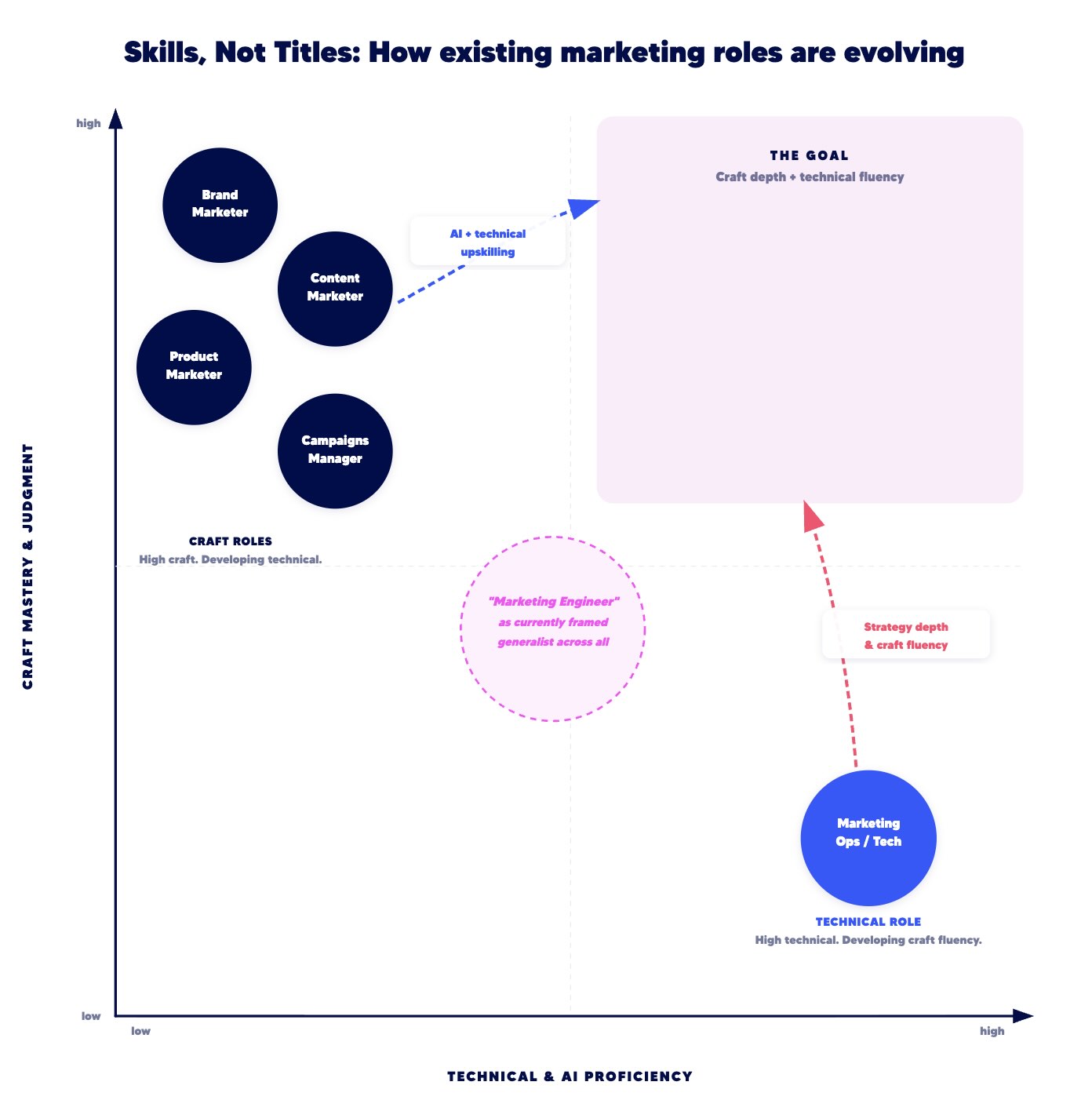
Every role moving toward the top right: the craft experts becoming more technical, and the technical people acquiring more craft fluency, from different starting points, at different speeds. That’s a model that delivers compounding results and a way to upskill marketers everywhere, instead of one new hire in the middle.
As a follow up to the Craft Mastery × AI Proficiency mental model, I’m going to write about what a real-life process mapping could look like for a B2B marketing team, and where the craft experts are leveraged, and where the technical infrastructure experts would sit. I’ll also start to dig into the skills marketers should prioritise as they move ahead in their careers in this moment in time, and then where to apply them in the co-creation of new workflows and processes with their leads and team mates.
Anne-Marie Goulet is the founder of Swim Club, a strategic practice for founders and marketing leaders who are done with the theatre. She spent 15 years inside Salesforce, Shopify, and WordPress Enterprise leading global marketing teams. Say hi at anne-marie@joinswimclub.com.